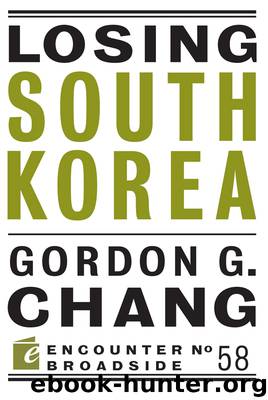
Losing South Korea by Gordon G. Chang
Author:Gordon G. Chang [Chang, Gordon G.]
Language: eng
Format: epub
ISBN: 9781641770699
Publisher: Encounter Books
Published: 2019-03-05T16:00:00+00:00
Moon puts trust not in the alliance with America but in friendship with his country’s enemy. And he sometimes shows more allegiance to that enemy than to the state he was elected to lead.
Since the beginning of the 1990s, the estimated cost of Korea’s unification has varied from about $600 billion to $5 trillion, with estimates rising over time. When President Roh Tae Woo said in 1991 that “our people do not want accelerated unification,” he was telling the truth. Since the early 1990s, in truth, the cost has always been thought to be too high.
This general attitude, bordering on selfishness, has limited what Moon can do to support the Kim regime, especially at a time when his own economy is ailing. Moreover, there are broad segments of the South Korean electorate, the oldest and the youngest, that are generally skeptical of his outreach to the North.
Older voters remember the June 1950 invasion by North Korea and harbor unshakably unfavorable views of the Kim regime. Moon’s attempts at bridge-building with the current Kim, such as removal of textbook references to the invasion of the South, are particularly unwelcome in the top age cohorts.
Younger voters do not appear to buy into Moon’s unificationist stance either. Many of them do not see their country as “Korea,” instead identifying themselves as South Koreans. They perceive the North as a nuclear threat, a destitute state, and a belligerent neighbor. The North Koreans are, in a word, foreigners. In a poll conducted in 2017 by the Korea Institute for National Unification, only 38.9 percent of respondents in their twenties favored unification.
That same survey found relatively high support for unification in society as a whole, with 57.8 percent favoring it. Yet the push for union with the North has been faltering. A survey in 2014 had found 69.3 percent favoring a merging of the two Koreas.
Moon himself has lost appeal at times when the South Korean public believes that his unification policies have overreached, as in early 2018 when he forced the addition of North Korean players to the South’s women’s ice hockey team for the PyeongChang Winter Olympics in South Korea. His approval dropped to a four-month low in January 2018—down six percentage points in a week—due to resentment over this overbearing maneuver. Some polls showed a ten-point fall in two weeks. Few liked the idea that South Korean athletes were turfed off their own team for political reasons, and the Games were widely mocked as “the Pyongyang Olympics.” Younger South Koreans showed higher levels of disapproval in surveys.
This new nationalism in South Korea—not Korean nationalism but South Korean nationalism—undercuts the popularity of unification projects. As a result, Moon has only one realistic option for regaining popularity.
“This is not a country where logic prevails,” the late Usung Chung, a South Korean who maintained the provocative Eyes on Korea blog, told me in the middle of the last decade. “You have to appeal to the emotion. And that emotion changes so wildly.”
Download
This site does not store any files on its server. We only index and link to content provided by other sites. Please contact the content providers to delete copyright contents if any and email us, we'll remove relevant links or contents immediately.
| Arms Control | Diplomacy |
| Security | Trades & Tariffs |
| Treaties | African |
| Asian | Australian & Oceanian |
| Canadian | Caribbean & Latin American |
| European | Middle Eastern |
| Russian & Former Soviet Union |
The Secret History by Donna Tartt(18998)
The Social Justice Warrior Handbook by Lisa De Pasquale(12177)
Thirteen Reasons Why by Jay Asher(8873)
This Is How You Lose Her by Junot Diaz(6856)
Weapons of Math Destruction by Cathy O'Neil(6248)
Zero to One by Peter Thiel(5765)
Beartown by Fredrik Backman(5712)
The Myth of the Strong Leader by Archie Brown(5481)
The Fire Next Time by James Baldwin(5409)
How Democracies Die by Steven Levitsky & Daniel Ziblatt(5200)
Promise Me, Dad by Joe Biden(5130)
Stone's Rules by Roger Stone(5065)
A Higher Loyalty: Truth, Lies, and Leadership by James Comey(4937)
100 Deadly Skills by Clint Emerson(4899)
Rise and Kill First by Ronen Bergman(4758)
Secrecy World by Jake Bernstein(4727)
The David Icke Guide to the Global Conspiracy (and how to end it) by David Icke(4684)
The Farm by Tom Rob Smith(4486)
The Doomsday Machine by Daniel Ellsberg(4473)
